
Is iPAY9 Legit? Australia Reputation, Reviews and Trust Signals
 Available in AU
Australia reputation evidence guide
The current Trustpilot profile for ipay9.com is too small to support a broad conclusion about iPAY9. It shows only two reviews, both from reviewers marked as Australian, and the experiences are sharply mixed. That makes the review sample useful as a warning to investigate further, not as proof that the brand is either reliable or a scam. A better assessment separates anecdotal reviews from harder evidence: the official domain, the current ACMA register position, whether payment and withdrawal terms are documented clearly, whether support channels can be reached, and whether important claims can be independently corroborated.
Table of Contents
- What the current iPAY9 review sample actually tells you
- Reviews and regulatory evidence answer different questions
- Start with the domain before judging any iPAY9 claim
- Clear payment, bonus and withdrawal documentation matters more than marketing tone
- Support availability is a signal, but responsiveness is the real test
- A practical trust-signal checklist for Australian readers
- How to combine iPAY9 trust signals without over-reading one source
- Give each trust signal only the weight it can support
- How much weight to give iPAY9 reviews and reputation signals
What the current iPAY9 review sample actually tells you
The current Trustpilot profile for ipay9.com shows two reviews. Both reviewers are marked as Australian, and the visible experiences point in opposite directions: one is strongly negative while the other is strongly positive. With only two data points, there is no sound basis for turning that page into a representative measure of the wider player experience.
This is a sample-size problem before it is a sentiment problem. A very small set can be distorted by unusual experiences, self-selection and timing. People who post public reviews are not a random cross-section of every customer, and a review platform does not give you the denominator – the number of people who used the service but never posted anything.
That is why this page does not repeat individual allegations or praise as if they were verified brand-wide facts. The reviews can tell you which questions are worth checking, such as communication and withdrawals. They cannot establish what usually happens to Australian players.
Reviews and regulatory evidence answer different questions
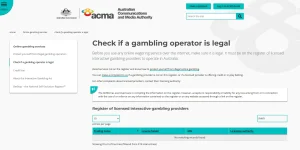
User reviews describe personal experience. A regulator register answers a narrower but much more objective question: whether a provider appears in the relevant licensing record. For Australia, ACMA maintains the register of licensed interactive gambling providers. A current check found no iPAY9 entry in that register.
The ACMA licence status therefore carries more weight for licensing than any review-site comment. At the same time, the absence of an Australian licence entry does not tell you whether a particular withdrawal request was handled quickly or whether customer support answered a specific user. Different evidence sources should be used for the questions they are actually capable of answering.
Start with the domain before judging any iPAY9 claim
The official public site identified for this guide is ipay9.com. That makes domain checking one of the simplest trust filters available to a reader. Search results, social posts, messages and copied promotional pages can point to lookalike domains, so a claim about iPAY9 is more useful when you can trace it back to the known brand domain or to an independent authority.
The practical process is simple: compare the hostname carefully, avoid assuming that a similar name is the same operator, and use the official login and domain when checking account access. A polished interface or familiar logo is not enough on its own because visual elements can be copied.
A failed page load is not reputation evidence. It does not establish that Australian users are blocked, and it does not establish that a service is legitimate. Reputation checks should stay focused on verifiable domain identity, documented terms, support behaviour and regulator records rather than treating a temporary access problem as a trust signal.
Clear payment, bonus and withdrawal documentation matters more than marketing tone
A useful reputation check looks for information that can be verified before money is committed. Promotional language is easy to publish; precise operating terms are more informative. For payments, readers should look for supported methods, the currency used, deposit minimums where clearly stated, and whether withdrawal rules are easy to find.
For withdrawals, exact limits, fees and processing times deserve particular scrutiny because these are high-impact details. Where current primary terms do not clearly establish a number, this guide does not invent one or substitute a conflicting third-party figure. The separate withdrawal checks explains what is confirmed and what remains uncertain.
The same principle applies to bonus terms. An offer headline can be visible while wagering, expiry or maximum-bet conditions are harder to verify. A stronger trust signal is not a large promotional number; it is a set of terms that can be located, understood and checked against what is shown during the account flow.
Another useful test is consistency across the account flow, terms and help material. If a payment, bonus or support claim appears in one place but disappears elsewhere, treat that mismatch as a reason to stop and verify rather than as a harmless formatting difference. Casino offers and operational details can change, so the strongest evidence is current, specific and independently checkable.
Support availability is a signal, but responsiveness is the real test
Multiple Australia-facing sources list 24/7 live chat for iPAY9, and email support is also publicly referenced. WhatsApp and Telegram are listed among support channels by multiple third-party sources. Those facts are useful because they show several routes for contacting the service, but the existence of a channel does not prove that a difficult account or withdrawal issue will be resolved well.
A practical test is to ask a specific, non-sensitive question before depositing: which terms govern withdrawals, where identity-verification requirements are documented, or which page contains the current bonus conditions. Save the response if it affects a later decision. A clear answer that points to written terms is more useful than a generic reassurance.
Do not send passwords, one-time codes or unnecessary personal documents through informal messaging channels. If support asks for sensitive verification material, first confirm that the request comes through the expected account or support process.
A practical trust-signal checklist for Australian readers
| Signal | What to verify | Why it matters |
|---|---|---|
| Domain | The hostname is ipay9.com when using the official public site | Reduces the risk of judging or entering details on a lookalike page |
| Australian licence | Check the live ACMA register rather than marketing copy | Licensing is a regulator fact, not a review-site opinion |
| Reviews | Check sample size, dates and whether experiences are mixed | Prevents two or three anecdotes from becoming a brand-wide verdict |
| Payments | Confirm the exact method, currency and current terms shown to your account | Payment availability can differ from withdrawal availability |
| Withdrawals | Locate written limits, fees, verification conditions and timing language | These details determine whether a payout claim can be checked later |
| Support | Test whether support answers a precise terms question and points to documentation | Responsiveness is more informative than merely listing a chat icon |
| Corporate or foreign-licence claims | Look for independently verifiable regulator or company records | Current public claims about iPAY9’s foreign licence and operator identity conflict, so this guide does not state one as fact |
How to combine iPAY9 trust signals without over-reading one source
A sensible assessment uses a hierarchy of evidence. Primary regulator records are strongest for licensing. Official-domain material is strongest for what the brand currently publishes about its own product, while independent sources can corroborate ordinary feature claims. User reviews are best treated as anecdotal reports that may reveal questions to investigate rather than answers that automatically generalise.
When sources conflict, the conflict itself is useful information. Current public material does not support a clean, independently verified statement about iPAY9’s foreign licence or operator company, so those claims should remain unresolved rather than being filled in from whichever review page sounds most confident.
Readers who want the broader product context can return to the full iPAY9 Australia review. The key is to keep convenience, reputation and regulation as separate dimensions instead of allowing one attractive feature or one negative story to decide all three.
Give each trust signal only the weight it can support
A small review sample can show that people have reported experiences, but it cannot establish a normal outcome for every user. A domain check can establish which public site is being discussed, but it cannot prove licensing. Clear payment and bonus terms can improve transparency, but they do not replace a regulator record. Treating each signal according to the question it can actually answer prevents one positive or negative detail from becoming an overall verdict.
For iPAY9, that means keeping the mixed review sample in its proper place and checking harder evidence separately. Use the official-domain question for identity, the ACMA material for Australian regulatory status, the live account or terms for current transaction conditions, and support interactions for issue handling. Where those sources disagree or remain incomplete, the uncertainty itself is more useful than filling the gap with a broad claim that the brand is safe, unsafe or a scam.
How much weight to give iPAY9 reviews and reputation signals
The current ipay9.com review sample is too small and mixed to justify a sweeping conclusion. Give more weight to facts that can be independently checked: the domain you are using, the ACMA register position, written payment and withdrawal terms, and whether support can point you to clear documentation. Treat individual reviews as prompts for due diligence rather than proof of a general pattern. For iPAY9 in Australia, the quality of the evidence matters more than the confidence of any single review.
iPAY9 Payments Australia: AUD Deposits, Cards, PayID and Banking

iPAY9 Games Australia: Pokies, Live Casino and Providers
Australia games guide iPAY9's verified game mix includes slots or pokies-style games, live casino and...
iPAY9 Licence Australia: ACMA Status, Law and Player Protections
Australian licence and law guide No Australian licence was verified for iPAY9 in the Australian...

iPAY9 Bonus Australia: $39.99 Free Chips and the Terms That Matter
Australia bonus guide iPAY9 currently advertises $39.99 in free chips for a new registration in...

iPAY9 Payments Australia: AUD Deposits, Cards, PayID and Banking
Australia payments guide The payment methods currently corroborated for iPAY9 include Visa, Mastercard, bank transfer,...

iPAY9 Mobile Australia: Browser Play, App Claims and Device Access
Australia mobile access guide iPAY9 is currently supported for mobile-browser use on iOS and Android...

iPAY9 Registration and KYC Australia: Account Setup Explained
Australia account setup guide iPAY9 is publicly marketed to Australian users and its account journey...