
iPAY9 Licence Australia: ACMA Status, Law and Player Protections
 Available in AU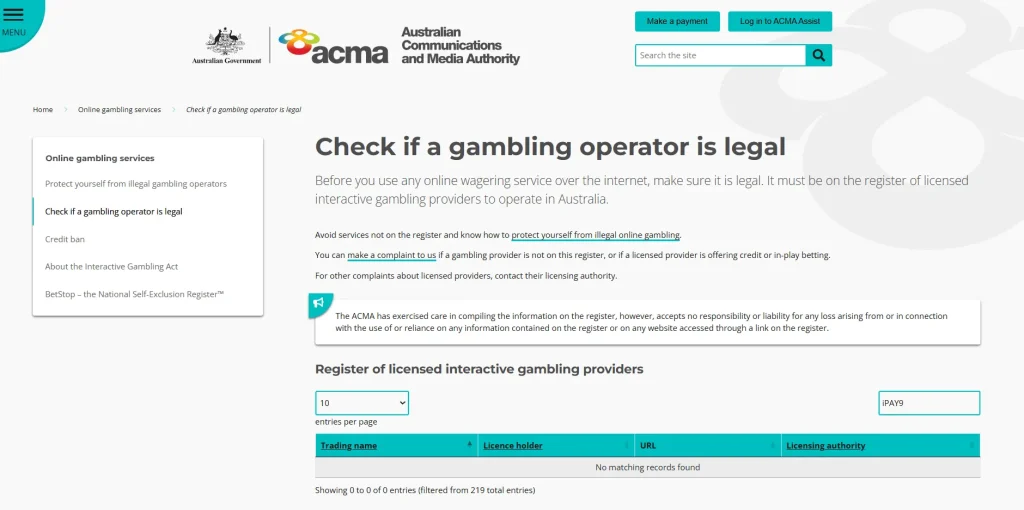
Australian licence and law guide
No Australian licence was verified for iPAY9 in the Australian Communications and Media Authority register when it was rechecked on 20 September 2026. ACMA also states that the Interactive Gambling Act 2001 makes it illegal for providers to offer online casino services to people in Australia. Those are provider-side regulatory facts. They should not be rewritten into the broader statement that an Australian player automatically commits an offence merely by visiting an offshore casino site. The practical issue for a reader is that iPAY9 should not be treated as an Australian-licensed wagering service, and protections that depend on that licensed status should not be assumed to apply.
Table of Contents
- What the ACMA register check shows for iPAY9
- The Interactive Gambling Act focuses on what providers may offer
- Why licensed wagering and online casino services are not interchangeable
- Australia also bans advertising for prohibited online casino services
- ACMA uses investigations, warnings and website blocking
- The 2026 reforms strengthen the framework, with most changes starting in 2027
- BetStop does not automatically extend to an offshore online casino
- The National Consumer Protection Framework has a defined scope
- What the licence result changes for practical risk checks
- Licence evidence and reputation evidence answer different questions
- A five-part regulatory check for Australian readers
- What ACMA status changes for an iPAY9 decision in Australia
What the ACMA register check shows for iPAY9
ACMA publishes a register of licensed interactive gambling providers and tells consumers to check that register before using an online wagering service. The current register was searched for iPAY9 and common spelling variants on 20 September 2026. No iPAY9 entry was found.
That result supports a narrow statement: no Australian licence was verified for iPAY9 in the ACMA register on the date of the check. It does not identify which foreign company may operate the brand, and it does not verify any overseas licence. Current public material makes conflicting claims about foreign licensing and operator identity, so this page does not choose one of those claims and present it as fact.
The distinction is important because the phrase “licensed casino” can hide several different questions. A licence from an overseas jurisdiction is not an Australian licence. A brand’s own licensing claim is not the same as a regulator-register match. And a website being accessible from Australia does not establish that it has permission to provide the service under Australian law.
The Interactive Gambling Act focuses on what providers may offer
Australia’s federal online-gambling framework is set by the Interactive Gambling Act 2001. ACMA’s current explanation of the Act says it is illegal for gambling providers to offer certain online services to people in Australia. The banned list includes online casinos, in-play sports betting and sports-betting services that do not hold an Australian licence.
For iPAY9, the relevant category is the online-casino rule. ACMA states that online casino services must not be provided to people in Australia. This is why the absence of an iPAY9 entry in the Australian licensed-provider register is not a minor administrative detail. Australian licensing and the federal prohibition operate in a framework designed around permitted wagering services, not a general licensing pathway for offshore online casinos.
Readers comparing product features can use the full iPAY9 Australia review, but legal status should be assessed independently from game variety, payment convenience or promotional value.
Why licensed wagering and online casino services are not interchangeable
Australian law permits some interactive wagering services when they are licensed under Australian state or territory law and comply with federal requirements. The ACMA register is therefore populated with licensed wagering brands and their licence holders. That does not mean the same framework authorises online casino-style products such as internet slots, roulette or casino table games.
This distinction explains why an Australian-facing casino can advertise AUD, PayID or familiar payment methods without becoming an Australian-licensed gambling provider. Payments and localisation are product facts. Regulatory authorisation is a separate fact that requires a register check.
The same separation applies to account features. The account and KYC describes the account journey, but a functioning sign-up process is not evidence of an Australian licence. Likewise, successful deposits or withdrawals do not create local regulatory status.
Australia also bans advertising for prohibited online casino services
ACMA’s current gambling-advertising guidance states that advertisements for prohibited interactive gambling services are banned on television, radio and online. The regulator explicitly includes online casino-style services in that category.
That rule matters when evaluating highly promotional Australian-facing pages. A page can use Australian language, quote amounts in AUD or feature local payment references, but those marketing signals do not establish lawful Australian licensing. For the same reason, this guide treats promotional claims separately from the licence question and does not use them as evidence of regulatory approval.
The bonus terms examines the current offer as a product term, not as proof of legal status. A bonus can be real as a commercial offer while the service remains outside Australia’s licensed wagering register.
ACMA uses investigations, warnings and website blocking
ACMA can investigate online gambling services and take enforcement or disruption action when it finds breaches of the Interactive Gambling Act. Its blocked-sites guidance says it can ask Australian internet service providers to block websites involved in serious breaches, including prohibited online casino services, unlicensed regulated wagering and illegal gambling advertising.
Current enforcement reporting shows that this power is actively used rather than merely theoretical. For April to June 2026, ACMA reported 30 investigations involving 76 gambling sites, 56 breach findings, 18 formal warnings and 187 websites referred to internet service providers for blocking. Those figures describe the regulator’s overall enforcement activity; they are not an allegation that iPAY9 itself was the subject of one of those actions.
That last distinction is essential. The current ACMA material checked on 20 September 2026 does not establish an iPAY9-specific blocking order or enforcement case. Readers should not infer one merely from the existence of ACMA’s general blocked-sites program.
The 2026 reforms strengthen the framework, with most changes starting in 2027
Australia enacted the Interactive Gambling Amendment (Gambling Reform) Act 2026 in August 2026. The Federal Register of Legislation records the Act as No. 72 of 2026, with assent on 26 August 2026.
ACMA says the reform package includes tighter gambling-advertising restrictions, a global opt-out register for gambling advertising, restrictions on some direct marketing of inducements, a ban on customer-activity-based commissions to staff or affiliates, stronger disruption powers for illegal gambling services and changes involving BetStop. ACMA also says most of the reforms commence on 1 January 2027.
That timing matters on 20 September 2026. The Act has been enacted, but readers should not assume that every reform measure is already operating in its future form. Where a protection depends on a commencement date, the current rule and the future rule need to be kept separate.
BetStop does not automatically extend to an offshore online casino
BetStop – the National Self-Exclusion Register lets people exclude themselves from Australian licensed online and phone wagering services. ACMA describes the participating providers as licensed wagering providers and explains that they must close accounts, prevent new bets and stop marketing to people who are self-excluded.
Because no Australian licence was verified for iPAY9 in the ACMA register, this page does not state that BetStop covers iPAY9. A user registered with BetStop should not assume the register will technically block access to every offshore casino site. BetStop remains a significant Australian protection, but its scope is tied to the licensed wagering system.
The same logic applies to dispute handling and account protections that depend on an Australian licence holder. Without a matching Australian licensed provider, this guide does not imply access to a local licensing authority’s complaint process for iPAY9.
The National Consumer Protection Framework has a defined scope
The Australian Government’s National Consumer Protection Framework for Online Wagering applies to licensed online wagering service providers. It includes measures covering identity verification, deposit limits, activity statements, account closure, consistent gambling-risk messaging, staff training and national self-exclusion.
Those measures are useful context because they show what Australian consumers can expect within the licensed wagering system. They should not be represented as automatic protections on an offshore casino that is not verified in that system. In practical terms, the absence of a register match changes what a reader can safely assume about recourse, self-exclusion interoperability and the enforceability of Australian wagering safeguards.
What the licence result changes for practical risk checks
| Question | Verified position | Practical implication |
|---|---|---|
| Australian licence | No iPAY9 entry was found in the ACMA register on 20 September 2026. | Do not treat iPAY9 as an Australian-licensed wagering provider. |
| Online casino provision | ACMA says providers must not offer online casino services to people in Australia. | Australian-facing access or localisation does not establish lawful provider status. |
| BetStop | Covers Australian licensed online and phone wagering services. | Do not assume it covers iPAY9 without a licensed-provider match. |
| National consumer framework | Applies to licensed online wagering service providers. | Do not transfer those protections automatically to an offshore casino. |
| Foreign licence | Current public claims about iPAY9’s overseas licence and operator identity conflict. | Do not rely on an unverified foreign licence number or company name. |
For financial due diligence, the withdrawal checks focuses on what is and is not verified about payout handling. Regulatory status cannot predict an individual withdrawal outcome, but it does affect what formal Australian protections should be assumed if a dispute develops.
Licence evidence and reputation evidence answer different questions
Regulator records answer whether a provider is licensed within a defined jurisdiction. User reviews answer what a small, self-selected group of customers say happened to them. Neither should be substituted for the other.
The dedicated reputation and reviews page handles customer-review evidence separately. That avoids the common mistake of treating one positive payout review as proof of regulatory approval or one complaint as proof of a legal finding.
The same discipline applies to foreign-licence claims. A promotional page can state a licence jurisdiction, but until that claim is verified through an acceptable source it remains different from a regulator record. This page therefore leaves conflicting operator and overseas-licence claims out of its factual conclusions.
A five-part regulatory check for Australian readers
1. Check the register
Search the ACMA licensed interactive gambling provider register for the brand, licence holder and domain rather than relying on marketing language.
2. Identify the product
Separate licensed wagering from online casino-style games because Australian rules treat those categories differently.
3. Check protection scope
Ask whether BetStop, deposit-limit rules or complaint pathways actually apply to the operator in question.
4. Date the evidence
Regulatory registers and reform commencement dates change. A dated check is more useful than an undated claim that a site is simply “legal” or “licensed”.
5. Keep product claims separate
A bonus, PayID deposit or mobile login can be verified as a feature without proving Australian regulatory approval.
What ACMA status changes for an iPAY9 decision in Australia
The current ACMA register does not show iPAY9 as an Australian licensed interactive gambling provider, while ACMA says online casino services are prohibited for providers to offer to people in Australia. That combination means readers should not assume the local protections attached to Australia’s licensed wagering system, including BetStop coverage and National Consumer Protection Framework safeguards, apply to iPAY9. It also means Australian-facing branding, AUD support or account access should be treated as product-access signals rather than regulatory approval. The useful way to assess iPAY9 is to keep those categories separate: verify product facts on their own pages, use ACMA and Australian legislation for legal claims, and avoid filling gaps with conflicting foreign-licence or operator-company claims.